
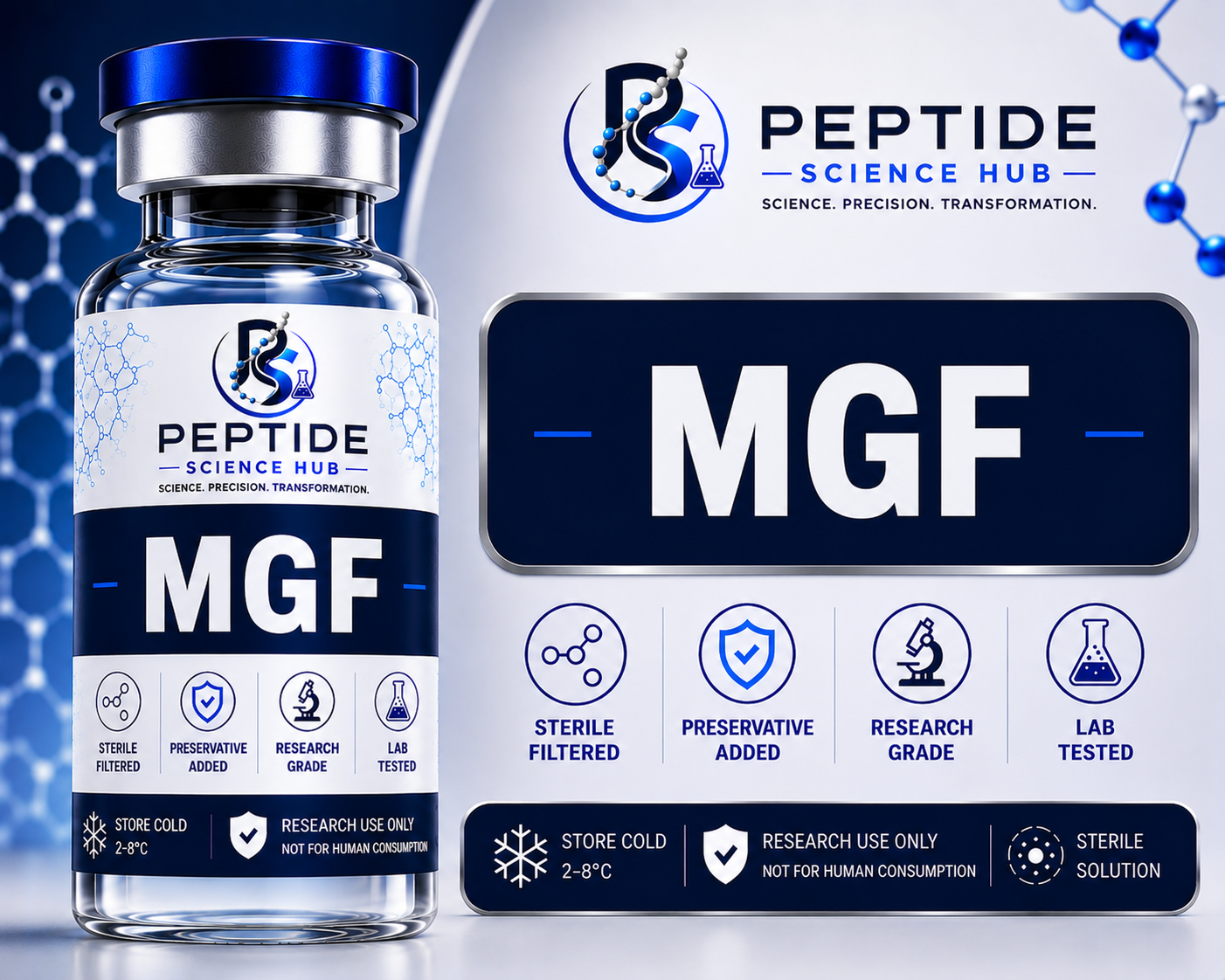


Mechano Growth Factor (MGF), also known as IGF-1Ec in humans, represents a splice variant of the Insulin-like Growth Factor-1 (IGF-1) gene. Muscle tissue produces MGF locally in response to mechanical stimulation and tissue damage, unlike systemic IGF-1 (IGF-IEa), which the liver produces . A unique 49-base pair insert in exon 5 of the human IGF-1 gene creates a reading frame shift, resulting in a distinct C-terminal E-peptide of 24 amino acids. This unique structure gives MGF its special biological functions .
How Does MGF Work Biologically?
MGF plays a primary role in activating and replenishing muscle stem cells (satellite cells), which are essential for muscle repair, hypertrophy, and adaptation to exercise . Research has demonstrated that MGF significantly increases the proliferative life span of satellite cells and delays their senescence, thereby supporting muscle maintenance and repair . MGF acts as an initial “kick-start” for muscle growth, occurring earlier than other IGF-1 isoforms in response to exercise . Beyond muscle, MGF shows potential in tendon repair by promoting tenocyte migration through the FAK-ERK1/2 signaling pathway. It also influences bone tissue by affecting osteoblast proliferation .
What Is PEG-MGF and Why Does It Matter?
Native MGF E-peptide has an extremely short half-life of minutes in biological fluids, which makes it impractical for research use . Therefore, researchers use PEG-MGF, a synthetic version where polyethylene glycol (PEG) attaches to the peptide to extend its circulating half-life from minutes to potentially days . However, PEG-MGF represents a synthetic construct with potentially different receptor binding and distribution profiles compared to the native peptide . Currently, no comparative human data exists for either form .
What Is the Regulatory Status and What Are the Research Limitations?
Importantly, MGF is not FDA-approved and remains an investigational compound. However, the FDA has announced its Pharmacy Compounding Advisory Committee (PCAC) will review PEG-MGF for potential inclusion on the 503A Bulk Drug Substances List by February 2027 . Despite this positive regulatory development, significant research limitations exist. For instance, a study from two pharmaceutical companies reported that MGF peptides, at concentrations up to 500 ng/ml, failed to increase proliferation of human or mouse muscle myoblasts in vitro, which calls its physiological role into question . Additionally, an observational clinical trial from September 2025 is investigating whether serum IGF-1EC levels correlate with tumor burden in solid tumors, highlighting possible cancer concerns . Consequently, human interventional data on MGF supplementation is entirely absent.
Internal Links
-
Explore our guide on [IGF-1 Splice Variants and Muscle Biology].
-
Learn about [Satellite Cells and Muscle Regeneration].
-
Read about [PEGylation and Peptide Half-Life Extension].
-
Understand [The FDA PCAC Process for Peptides].
-
View our [Peptide Sourcing and Safety Guidelines].
External Links
-
Read the 2011 study on MGF-E peptide and human muscle progenitor cells via [PubMed].
-
Review the 2003 Journal of Physiology human exercise study via [Europe PMC].
-
Access the FDA Law Blog discussion on PEG-MGF regulatory review via [FDA Law Blog].
-
Learn about MGF-E peptide inhibition of osteoblast differentiation via [ScienceDirect].
-
Understand MGF-C25E effects on tenocyte migration via [OSTI.GOV].
| MGF | 2mg |
|---|
Be the first to review “MGF (Mechano Growth Factor)”
Related products
Aesthetic

Cognitive Peptides

Performance Peptides

Metabolic Modulators

Cognitive Peptides

Aesthetic
Immune Peptides

Performance Peptides
Reviews
There are no reviews yet.