
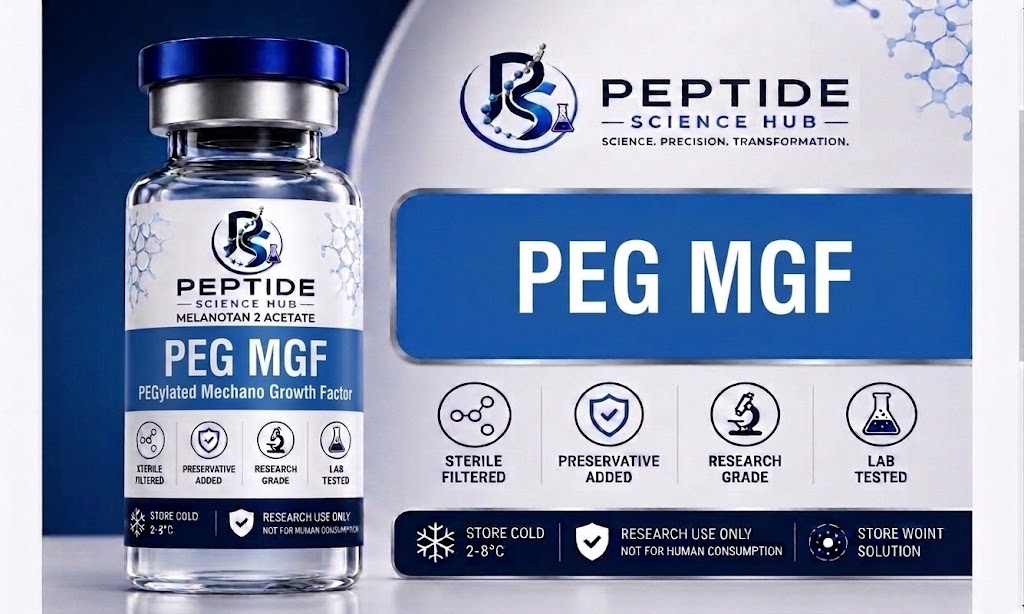

PEG-MGF is a synthetic derivative of Mechano Growth Factor (MGF), which is a splice variant of the insulin-like growth factor 1 (IGF-1) gene . Native MGF is a 24-amino acid peptide that acts as a brief, local repair signal following mechanical stress on muscle tissue . The PEGylation process—attaching a PEG polymer to the peptide—extends its half-life from approximately 5-7 minutes to several hours . Additionally, the peptide features D-form arginine substitutions at positions 14 and 15 for enhanced stability . Its molecular formula is C121H200N42O39 with a molecular weight of approximately 2948.15 g/mol .
2. Mechanism of Action
PEG-MGF retains the core biological activity of native MGF. Unlike IGF-1, MGF does not bind to the IGF-1 receptor (IGF-1R) . Instead, it signals through a distinct, unidentified receptor pathway. The primary role of MGF is activating quiescent satellite cells, which are the resident stem cells of skeletal muscle . This activation stimulates satellite cell proliferation and expansion of the progenitor cell pool . Importantly, MGF promotes proliferation without premature differentiation, maintaining the stem cell pool for effective tissue repair . The PEG modification is biologically inert and serves purely as a pharmacokinetic enhancer .
[Image Placeholder: Chart showing PEG-MGF satellite cell activation pathway]
Alt text: PEG-MGF mechanism of action showing satellite cell activation and proliferation
3. Research Applications
PEG-MGF has multiple research applications across different tissue types. In skeletal muscle studies, researchers investigate its role in satellite cell activation, myoblast proliferation, and muscle repair following injury or damage . Additionally, cardiac research explores potential cardioprotective effects, with animal models suggesting benefits following myocardial infarction . Furthermore, connective tissue studies examine possible roles in tendon, ligament, and bone regeneration . In tissue engineering, PEG-MGF is incorporated into biomaterial scaffolds to evaluate effects on cellular proliferation and matrix remodeling .
[Image Placeholder: Infographic of PEG-MGF research applications across tissue types]
Alt text: PEG-MGF research applications in muscle, cardiac, and connective tissue studies
4. Clinical Evidence and Limitations
The evidence base for PEG-MGF is exclusively preclinical. No published controlled human trials exist for PEG-MGF in any indication . Most studies use animal models or cell culture systems. Moreover, much of the supportive research uses native MGF or gene transfer rather than the pegylated injectable form . Consequently, the FDA has not approved PEG-MGF for any human use. The FDA places it in Category 2 of the 503A bulks list, indicating substances with significant safety concerns . Furthermore, no registered clinical trials exist on ClinicalTrials.gov .
[Image Placeholder: Graph showing evidence distribution for PEG-MGF research]
Alt text: PEG-MGF evidence distribution showing preclinical studies versus clinical data
5. Safety and Regulatory Status
The theoretical safety concern with PEG-MGF relates to its growth-factor nature. Human epidemiology links high IGF-1 activity to increased cancer risk . Additionally, PEGylated compounds can induce anti-PEG antibodies in some individuals, potentially leading to accelerated blood clearance with repeated dosing . The World Anti-Doping Agency (WADA) lists PEG-MGF as a prohibited substance . Furthermore, products sold online as research chemicals are not manufactured under pharmaceutical GMP conditions . Quality and purity remain unverified.
6. Storage and Handling
Store lyophilized PEG-MGF at -20°C to ensure long-term stability. Protect from light and keep containers tightly closed when not in use . Avoid repeated freeze-thaw cycles. Reconstitute in sterile water or appropriate buffer immediately before use. For more on peptide handling, review our Peptide Storage Guide. Externally, refer to the FDA guidelines on investigational drugs and the PubMed research repository for peer-reviewed literature.
7. Comparison with Native MGF
The key difference between PEG-MGF and native MGF is pharmacokinetic stability. Native MGF has a half-life of 5-7 minutes, while PEG-MGF extends to several hours . Native MGF acts as a local paracrine factor, whereas PEG-MGF achieves systemic distribution . Both forms activate satellite cells with equivalent potency in vitro . However, the sustained exposure from PEG-MGF raises questions about whether this non-physiological profile improves or undermines the biological intent .
8. Conclusion
PEG-MGF remains a research compound with an intriguing mechanism but no human clinical evidence. Its ability to activate satellite cells and promote tissue repair is well-described in cells and animals. Nevertheless, the human benefit has no controlled-trial support . Moreover, the growth-factor nature and unregulated supply give real reasons for caution . Researchers should use it only in controlled laboratory settings and follow standard safety protocols.
| PEG MGF | 2mg |
|---|
Be the first to review “PEG MGF”
Related products

Cognitive Peptides
Aesthetic

Performance Peptides
Therapeutic Peptides

Cognitive Peptides
Peptides Collection
Immune Peptides
Cognitive Peptides
Reviews
There are no reviews yet.