
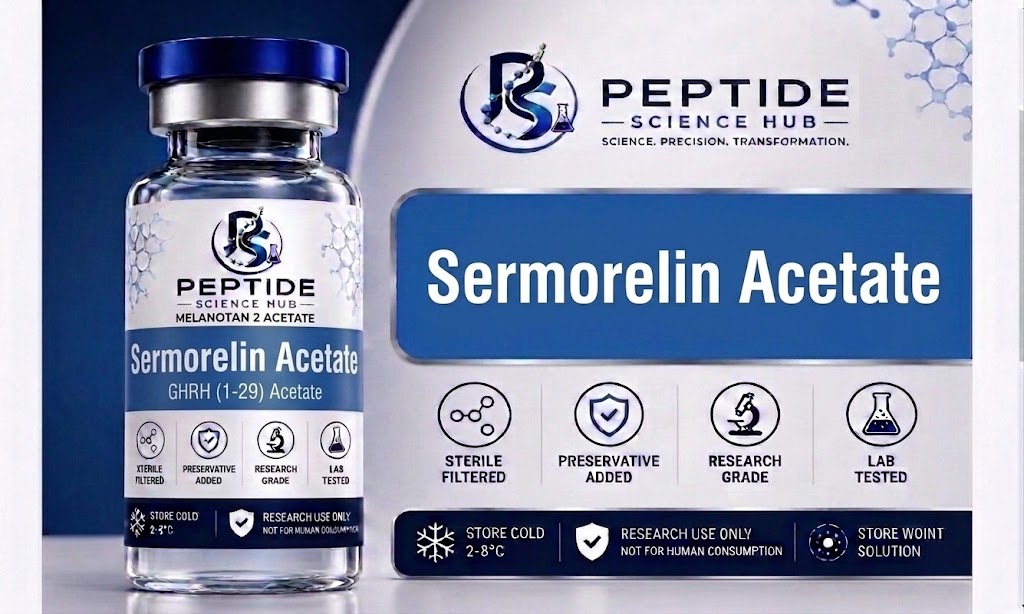
Sermorelin acetate is a synthetic peptide that corresponds to the first 29 amino acids of endogenous human growth hormone-releasing hormone (GHRH). It acts on the pituitary gland to stimulate the release of endogenous growth hormone (GH) in a natural pulsatile manner. Initially, developers created it as a diagnostic agent. Today, clinicians also use it for growth hormone deficiency and study it off-label for metabolic health applications.
[Image Placeholder: Diagram showing the endogenous GHRH (44 amino acids) compared to Sermorelin (29 amino acids)]
Alt text: Sermorelin Acetate compared to full-length GHRH structure
1. What Is Sermorelin Acetate?
Sermorelin acetate is a synthetic, amidated 29-amino-acid peptide. Its sequence is YADAIFTNSYRKVLGQLSARKLLQDIMSR-NH2. This sequence corresponds to the bioactive N-terminal segment of the naturally occurring 44-amino-acid GHRH. Its molecular formula is C149H246N44O42S. Its molecular weight is 3358.03 g/mol. The acetate salt form is the compound used in clinical and research applications.
2. Mechanism of Action
Sermorelin acetate binds to the growth hormone-releasing hormone receptor (GHRHR) on pituitary somatotroph cells. This binding activates adenylyl cyclase via G proteins. Consequently, it leads to increased GH secretion. By mimicking native GHRH, Sermorelin Acetate stimulates the anterior pituitary to release growth hormone in a rapid and specific manner. Moreover, because it stimulates endogenous production rather than introducing exogenous GH, it preserves the body’s natural feedback loop.
[Image Placeholder: Chart showing Sermorelin Acetate binding to GHRHR and stimulating GH release]
Alt text: Sermorelin Acetate mechanism of action at the pituitary GHRH receptor
3. Clinical Applications
Initially, the FDA approved Sermorelin Acetate as a diagnostic agent. Clinicians used it to assess GH secretion in patients with suspected growth hormone deficiency. The brand product Geref received approval in 1997 but later discontinued in 2008. Today, licensed pharmacies compound Sermorelin Acetate for off-label adult metabolic health applications. These include supporting lean mass retention, aiding recovery, and addressing age-related declines in GH levels. Furthermore, studies explore its potential role in Alzheimer’s disease research. Importantly, off-label prescribing of Sermorelin Acetate is a legal practice known as “off-label prescribing.”
[Image Placeholder: Infographic showing clinical applications of Sermorelin Acetate]
Alt text: Sermorelin Acetate clinical applications in diagnosis and metabolic health
4. Safety Profile
Sermorelin Acetate is generally safe when prescribed by qualified providers. However, safety depends on individual health status and proper monitoring. Common side effects are mild and dose-dependent. Injection site reactions occur in 10-30% of patients. Systemic effects like flushing, dizziness, and headache appear in fewer than 15% of cases. Transient hyperglycemia (3-8%) and acute cortisol elevation (2-5%) are well-documented. These typically resolve spontaneously. Furthermore, serious adverse events are rare, occurring in under 5% of users.
[Image Placeholder: Chart of Sermorelin Acetate adverse event incidence rates]
Alt text: Sermorelin Acetate side effects and incidence rates from clinical data
5. Regulatory Status
The FDA has not currently approved Sermorelin Acetate for adult metabolic or anti-aging uses. The FDA-approved brand Geref was withdrawn from the market in 2008. Today, 503A pharmacies offer Sermorelin Acetate as a compounded peptide. Published research and clinical observation support its use. Nevertheless, it lacks formal regulatory endorsement for many applications patients seek. Consequently, monitoring of IGF-1 levels, fasting glucose, and lipids is essential for safe and effective long-term use.
6. Storage and Handling
Store lyophilized Sermorelin Acetate at -20°C to ensure long-term stability. Protect it from light. Keep containers tightly closed. Avoid repeated freeze-thaw cycles. Reconstitute the peptide in sterile water or bacteriostatic water immediately before use. For more on peptide handling, review our Peptide Storage Guide. Externally, refer to the FDA guidelines on investigational drugs and the PubMed research repository for peer-reviewed literature.
7. Conclusion
Sermorelin Acetate remains a well-studied peptide with a clear mechanism and a documented safety profile. Its role in stimulating endogenous GH release makes it a valuable research tool. Moreover, it serves as a viable option for off-label clinical use under physician supervision. Nevertheless, its regulatory status for adult applications remains off-label. Therefore, researchers and patients should prioritize a comprehensive assessment with a qualified provider.
| Sermorelin Acetate | 2mg, 5mg, 10mg |
|---|
Be the first to review “Sermorelin Acetate”
Related products
Uncategorized
Uncategorized
Peptides Collection
Uncategorized
Uncategorized
Peptides Collection
Peptides Collection
Uncategorized
Reviews
There are no reviews yet.