
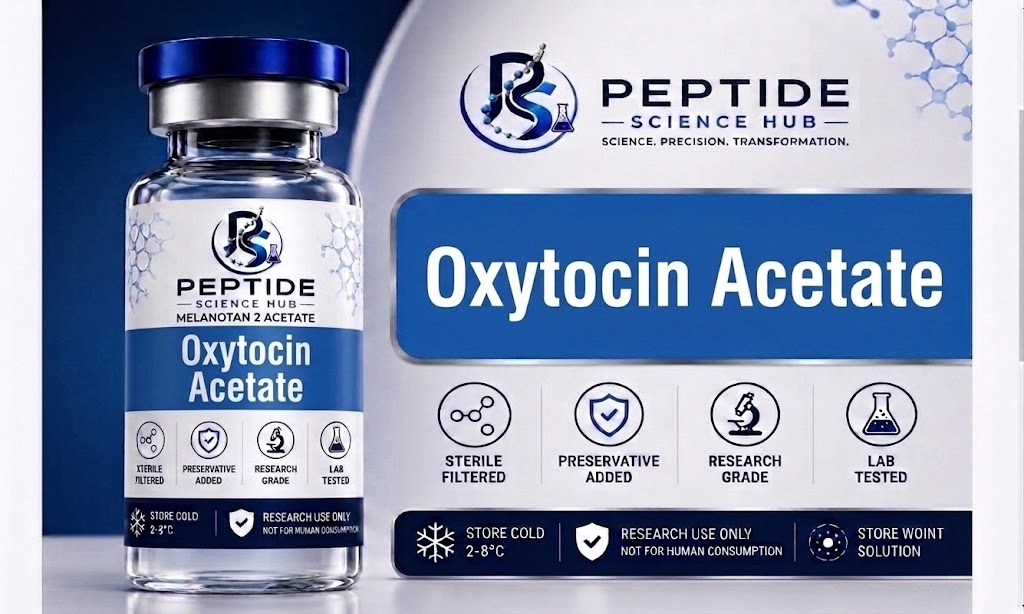

Oxytocin acetate is the acetate salt form of oxytocin, a 9-amino-acid cyclic peptide. The hypothalamus synthesizes this neuropeptide. It plays essential roles in labor, lactation, and social affiliation. Moreover, researchers prefer the acetate salt form for its superior performance in cell-based and animal studies.
[Image Placeholder: Diagram showing oxytocin synthesis in hypothalamus and release from posterior pituitary]
Alt text: Oxytocin Acetate synthesis pathway from hypothalamus to posterior pituitary release
1. What Is Oxytocin Acetate?
Oxytocin acetate (CAS 6233-83-6) is the acetate salt form of oxytocin. This compound is a 9-amino-acid cyclic peptide. The hypothalamus serves as its primary synthesis site. Its molecular formula is C43H66N12O12S2 · C2H4O2. Its molecular weight is 1067.2 g/mol. The peptide sequence is CYIQNCPLG. A disulfide bridge between Cys1 and Cys6 is critical for activity. The posterior pituitary secretes this neuropeptide into circulation. Consequently, it plays essential roles in labor, lactation, and social affiliation.
2. Why Choose the Acetate Salt Form?
Researchers should select oxytocin acetate over other salt forms for specific applications. In cell-based functional assays, the acetate salt is strongly recommended. It eliminates TFA-induced cytotoxicity. This ensures results reflect true receptor-mediated activity. For in vivo and animal studies, oxytocin acetate is the only appropriate choice. TFA can induce inflammatory or immune responses. These would compromise study outcomes. Therefore, the acetate salt provides a cleaner measure of biological potency.
3. Mechanism of Action
Oxytocin acts as a positive allosteric modulator of the μ-opioid receptor (MOR). It enhances receptor-mediated signaling without directly activating MOR. Moreover, it does not alter opioid ligand affinity. In vitro studies use hMOR-expressing HEK293 cells. These studies show oxytocin augments MOR agonist signaling. Agonists include endomorphin-1, morphine, and fentanyl. Furthermore, oxytocin enhances synaptic strength. It promotes long-term potentiation (LTP), which is critical for learning and memory. Additionally, it regulates synaptic proteins like PSD95 and Synapsin I.
[Image Placeholder: Chart showing oxytocin’s modulation of MOR signaling in HEK293 cells]
Alt text: Oxytocin Acetate enhances μ-opioid receptor signaling in cell-based functional assays
4. Research Applications
Preclinical studies demonstrate therapeutic potential across multiple domains. In postpartum depression models, oxytocin combined with rTMS attenuated depressive behavior. It downregulated apoptosis and increased synaptic plasticity. It also modulated microglia activity. Emerging research explores oxytocin for AVP deficiency, also known as central diabetes insipidus. Patients with this condition show heightened anxiety and impaired socioemotional functioning. Researchers also study oxytocin’s role in social behavior, trust formation, and emotion recognition.
5. Safety and Regulatory Status
The FDA has not approved oxytocin acetate for human use. Researchers should handle it as an investigational compound only. Common considerations include proper dosing and sterile handling. Always follow institutional safety protocols. Furthermore, ensure proper storage conditions to maintain peptide integrity.
6. Storage and Handling
Store lyophilized oxytocin acetate at -20°C to ensure long-term stability. Avoid repeated freeze-thaw cycles. Reconstitute the peptide in sterile water or PBS. Use it immediately after reconstitution. For more on peptide handling, review our Peptide Storage Guide. Externally, refer to the FDA guidelines on investigational drugs and the PubMed research repository for peer-reviewed literature.
[Image Placeholder: Infographic of oxytocin acetate storage and handling guidelines]
Alt text: Oxytocin Acetate storage temperature and reconstitution instructions
7. Conclusion
Oxytocin acetate remains a vital research tool for neuroscience and endocrinology. Its acetate salt form offers superior performance in cell-based and animal studies. Nevertheless, researchers should handle it with care. Always follow standard safety protocols.
| Oxytocin Acetate | 2mg |
|---|
Be the first to review “Oxytocin Acetate”
Related products
Uncategorized
Uncategorized
Uncategorized

Uncategorized
Peptides Collection
Peptides Collection
Uncategorized
Uncategorized
Reviews
There are no reviews yet.