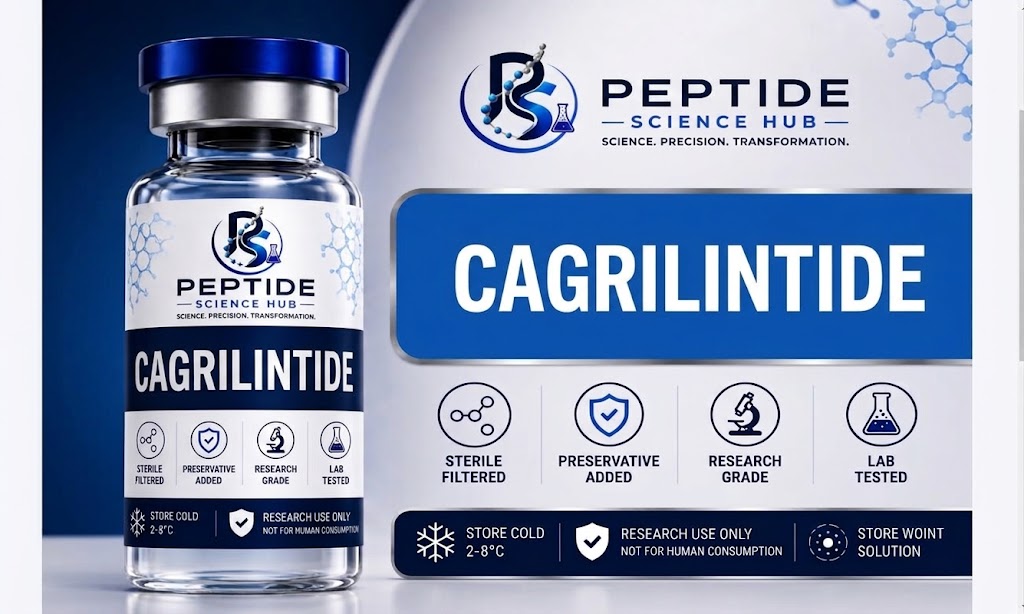
Cagrilintide (Cagri) is an investigational long-acting amylin analogue developed by Novo Nordisk . Amylin is a hormone co-secreted with insulin that regulates satiety and slows gastric emptying . Unlike GLP-1-based therapies, cagrilintide targets a distinct pathway, making it a novel approach for obesity management . The peptide functions as a dual amylin receptor (AMYRs) and calcitonin receptor (CTR) agonist, often referred to as a DACRA .
Clinical Trial Results
Phase 3 data from the REDEFINE 1 trial demonstrate promising outcomes. Participants receiving cagrilintide 2.4 mg once-weekly lost an average of 11.8% body weight compared to 2.3% with placebo . Furthermore, 31.6% of participants achieved weight loss of 15% or more versus 4.7% on placebo . A recent network meta-analysis ranked cagrilintide as a potent alternative to semaglutide, with a distinct safety profile featuring notably less vomiting than GLP-1 receptor agonists . Consequently, Novo Nordisk has advanced cagrilintide into a dedicated Phase 3 RENEW program .
Mechanism of Action
Cagrilintide works through dual receptor activation. Cryo-EM structures reveal that cagrilintide adopts similar “bypass” binding modes at both AMY1R and CTR receptors . Key molecular features include the F23 residue anchoring the peptide at the receptor transmembrane bundle and an E14-R17 intramolecular salt bridge that enhances helical stability . These features collectively enable non-specific binding and activation across different receptors . Additionally, research suggests cagrilintide may have kidney-specific effects. In diabetic rat models, cagrilintide elevated cAMP levels in cortical tubules, pointing to a diabetes-specific mechanism of action in the kidneys .
Safety Profile and Pharmacokinetics
Common adverse events include gastrointestinal effects like nausea, vomiting, diarrhea, and constipation . Importantly, cagrilintide demonstrated a favourable tolerability profile with nausea leading to discontinuation in only 1.0% of participants . Renal or hepatic impairment does not significantly affect the pharmacokinetics, safety, or tolerability of cagrilintide, according to separate clinical studies . For more on peptide safety, review our Peptide Safety Guide. Externally, refer to the FDA guidelines on investigational drugs and PubMed’s clinical trial database for peer-reviewed literature.
Regulatory Status and Ongoing Trials
The FDA has not approved cagrilintide. Several trials are currently active, including a Phase 3 comparability study (NCT07745504) and multiple Phase 1 pharmacokinetic trials . Novo Nordisk is also investigating the fixed-dose combination CagriSema, which pairs cagrilintide with semaglutide .
Conclusion
Cagrilintide represents a promising next-generation obesity therapy targeting a novel pathway. Nevertheless, regulatory approval remains pending. Therefore, patients and clinicians await further Phase 3 data to confirm long-term safety and efficacy.


Reviews
There are no reviews yet.