
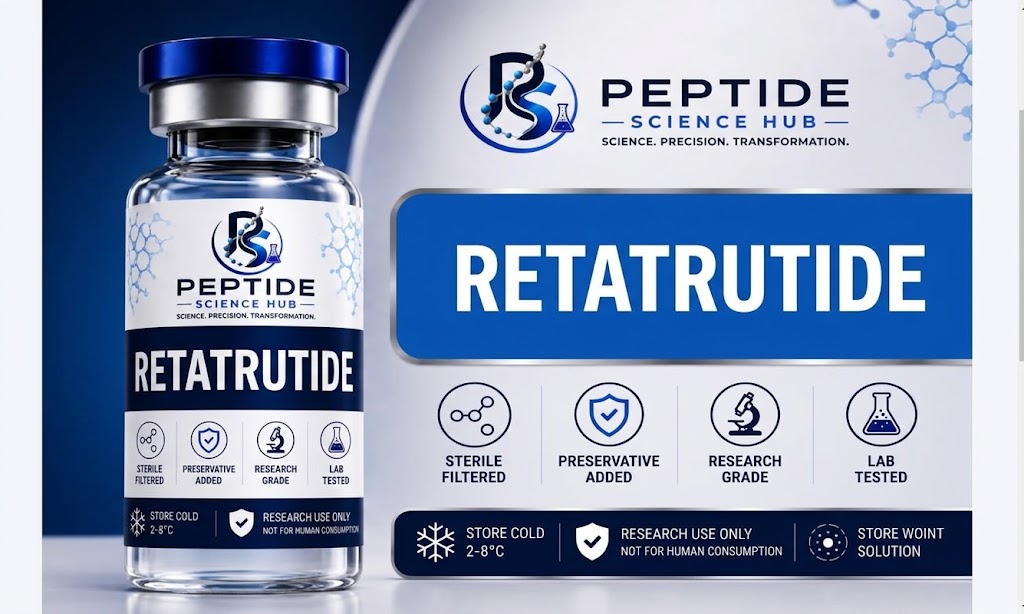
Retatrutide (LY3437943) is an investigational peptide developed by Eli Lilly. It acts as a triple hormone receptor agonist, targeting three receptors simultaneously: GIP, GLP-1, and glucagon. Unlike semaglutide (GLP-1 only) or tirzepatide (GIP + GLP-1), retatrutide adds glucagon agonism. This unique mechanism may increase energy expenditure and fat oxidation.
Clinical Trial Results
Phase 3 trials show impressive weight loss outcomes. In TRIUMPH-1 (2,339 adults with obesity), the 12 mg dose produced 28.3% average weight loss over 80 weeks. Among participants on 12 mg, 65.3% achieved a BMI below 30, and 33.3% reached a BMI below 25. A prespecified extension to 104 weeks showed participants with baseline BMI ≥35 lost an average of 30.3%. Furthermore, retatrutide reduced knee osteoarthritis pain scores by up to 4.3 points (73.1%). Additionally, it lowered apnea-hypopnea index by up to 60.6% in patients with moderate-to-severe sleep apnea. Moreover, improvements in cardiovascular markers were observed across all doses.
[Image Placeholder: Chart showing weight loss results across TRIUMPH clinical trials]
Alt text: Retatrutide weight loss results in Phase 3 TRIUMPH trials comparing doses and placebo
Mechanism of Action
Retatrutide works through its three-pronged approach. The GLP-1 component reduces appetite and slows gastric emptying. Meanwhile, the GIP component enhances insulin secretion and regulates fat metabolism. Similarly, the glucagon component increases energy expenditure. Importantly, recent research suggests retatrutide goes beyond caloric restriction. A 2026 study found it actively reverses adipose tissue dysfunction. Consequently, it modulates pathways involved in lipid handling, inflammation, and energy expenditure. Therefore, retatrutide offers a comprehensive metabolic effect.
[Image Placeholder: Diagram of retatrutide’s triple receptor activation and downstream effects]
Alt text: Retatrutide triple agonist mechanism activating GIP, GLP-1, and glucagon receptors for metabolic regulation
Safety Profile and Regulatory Status
Common side effects include nausea, diarrhea, vomiting, and constipation. In TRIUMPH-1, nausea rates reached 42.4% on the 12 mg dose versus 14.8% on placebo. Discontinuation due to adverse events occurred in up to 11.3% of retatrutide groups. Nevertheless, the FDA has not approved retatrutide. However, Eli Lilly plans to submit a Biologics License Application (BLA) in Q1 2027. Consequently, approval would likely follow in late 2027 or 2028.
[Image Placeholder: Infographic of retatrutide safety profile and common adverse events]
Alt text: Retatrutide side effects and adverse events from clinical trial data
Illegal Versions and Safety Warnings
Importantly, illegal versions purchased online have caused serious harm. Six cases of acute liver toxicity were reported in Victoria, Australia in 2026. All these cases linked to unapproved peptide products labelled as retatrutide. Investigators suspect contaminants may be contributing to the observed toxicity. Therefore, authorities strongly advise against purchasing retatrutide from unregulated sources. For more on peptide safety, review our Peptide Safety Guide. Externally, refer to the FDA guidelines on investigational drugs and PubMed’s clinical trial database for peer-reviewed literature.
Conclusion
Retatrutide represents a promising advancement in obesity pharmacotherapy. Nevertheless, safety monitoring and regulatory approval remain pending. Therefore, researchers and clinicians await Phase 3 completion to confirm long-term efficacy and safety. Ultimately, retatrutide may reshape the treatment landscape for obesity and related metabolic disorders.
| Retatrutide | 5mg, 10mg, 15mg, 20mg, 30mg |
|---|
Be the first to review “Retatrutide”
Related products
Peptides Collection

Uncategorized
Uncategorized

Uncategorized
Peptides Collection

Uncategorized
Uncategorized

Uncategorized
Reviews
There are no reviews yet.