
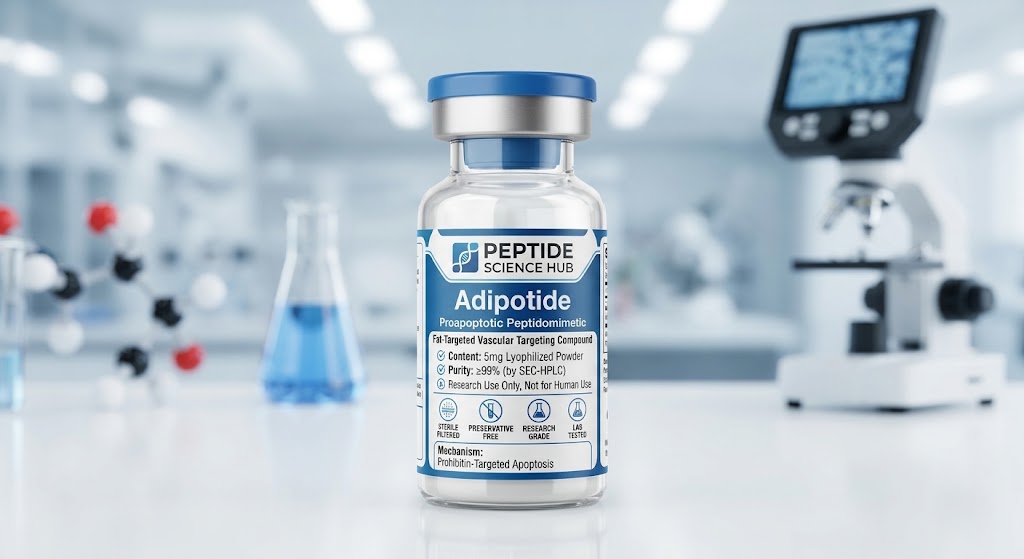
Adipotide, also known as FTPP (Fat-Targeted Proapoptotic Peptide), is a synthetic peptidomimetic compound. Researchers primarily use it for experimental investigation of adipose tissue-associated vascular targeting and apoptosis-related signalling pathways. Unlike traditional peptides, Adipotide does not work through hormonal or enzymatic pathways. Instead, it functions through a ligand-directed mechanism. This mechanism specifically targets receptors on the endothelial cells supplying white fat. Consequently, this unique mode of action has positioned Adipotide as a promising research tool. Scientists frequently employ it in obesity, metabolic dysfunction, angiogenesis, and oncology studies. Therefore, if you engage in preclinical metabolic research, understanding this compound is essential. You should seriously consider whether to buy Adipotide for your laboratory studies.
Structural Composition and Mechanism
Adipotide contains two functional domains. First, a homing peptide (CKGGRAKDC) binds to specific receptors on adipose vasculature. Second, a proapoptotic sequence (D(KLAKLAK)2) initiates programmed cell death. The homing domain specifically recognises and binds to proteins such as prohibitin and annexin A2. Notably, these proteins are selectively expressed on the surface of endothelial cells in white adipose tissue. Once bound, the proapoptotic domain internalises effectively. Subsequently, it triggers mitochondrial disruption and apoptosis in the targeted cells. This mechanism ultimately causes the collapse of the microvasculature that supplies white adipocytes. The collapse subsequently leads to ischemic injury and subsequent cell death. For these reasons, when you buy Adipotide for research, you acquire a compound with this unique dual-domain architecture.
Preclinical Research Findings
Rhesus Monkey Study
The most consequential study of Adipotide appeared in Science Translational Medicine in 2011. Barnhart and colleagues conducted this landmark research in non-human primates. The study enrolled spontaneously obese rhesus macaques (n = 10 treated, n = 5 controls). Researchers administered Adipotide at 0.43 mg/kg subcutaneously daily for 28 days. Treated primates lost approximately 10.6% of their body weight. Moreover, they also showed reductions in BMI and abdominal circumference. Imaging confirmed significant decreases in body fat (p < 0.0001). In contrast, untreated controls showed no change whatsoever. Additionally, insulin resistance improved in treated animals (p = 0.019). The compound was generally well-tolerated in all three species of nonhuman primates tested.
Rodent Studies
The Kim, Woods, and Seeley group published findings in Diabetes in 2012. They reported that the same proapoptotic peptide produced rapid improvement in glucose tolerance in obese C57BL/6 mice. This improvement occurred by days 2–3 of treatment. Importantly, it happened in a weight- and food-intake-independent manner (p < 0.05). Furthermore, the researchers observed significantly reduced serum insulin and triglycerides (both p < 0.05). This finding distinguishes the metabolic effects from simple fat loss. Moreover, it raises independent questions about how vascular disruption in adipose tissue affects systemic insulin signalling.
Safety Profile and Considerations
Renal Toxicity Signal
The primate study identified a primary safety signal. The signal was dose-dependent, reversible renal tubular degeneration and regeneration. This was accompanied by elevated serum creatinine that normalized post-treatment. Decreased serum phosphorus and potassium occurred during treatment. Urinary changes included mild-to-marked glucosuria, mild-to-moderate proteinuria, and a slight-to-mild increase in transitional/renal epithelial cells. These findings indicated altered proximal tubular function and tubular injury. Fortunately, these changes resolved during the recovery period.
Regulatory Status
As of 2026, Adipotide is not FDA-approved for any indication. It has no FDA drug application on file. It also has no approved label. Furthermore, it has no classification as a compoundable bulk drug substance under 503A or 503B. Consequently, there is no legal compounding pathway for Adipotide in the United States. Products sold through online vendors exist outside any regulatory framework. They have no FDA oversight of manufacturing. They also have no verified identity of the compound. Moreover, they have no guaranteed purity or potency.
Dosing and Administration for Research
For research applications, Adipotide is available as a lyophilized powder in various pack sizes. Typical research dosing protocols from published studies range from 0.25 to 0.75 mg/kg subcutaneous. The molecular formula is C152H252N44O42. The molecular weight is approximately 2611.41 g/mol. Recommended storage is at –20°C, desiccated, and protected from light. Reconstituted solutions should be stored at -80°C for extended stability. Therefore, when you buy Adipotide, ensure you have appropriate storage conditions and handling protocols in place.
Important Research Applications
Researchers are investigating Adipotide’s potential in several key areas. These include adipose tissue vascular biology, peptide-mediated targeting and internalisation, and apoptosis-related signalling pathways. Additionally, metabolic and vascular biology studies show promise. Furthermore, oncology applications targeting prohibitin-expressing cells are gaining attention. The compound’s design as a vascular-targeting agent has broader implications beyond adipose tissue. For instance, prohibitin has been implicated in various cancers including breast, prostate, and ovarian malignancies.
https://images.unsplash.com/photo-1576091160550-2173dba999ef?w=800&q=80
Alt text: Scientific diagram showing Adipotide’s dual-domain mechanism of action, helping researchers understand why to buy Adipotide for adipose vascular studies.
Take the Next Step – Buy Adipotide for Your Research Today
The scientific evidence strongly positions Adipotide as a valuable research tool. It is particularly useful for investigating adipose tissue vasculature, targeted apoptosis, and metabolic signalling pathways. The preclinical data demonstrate consistent efficacy across multiple model systems. Furthermore, the compound offers a unique approach to studying adipose biology. If you are a qualified researcher ready to advance your studies, buy Adipotide today from a trusted supplier. Ensure the supplier offers third-party tested material with high purity (≥99%) for laboratory research purposes only. Remember that all sales are for research use only by qualified researchers in a controlled laboratory environment.
https://images.unsplash.com/photo-1588776814546-1ffcf47267a5?w=800&q=80
Alt text: Molecular structure diagram of Adipotide (FTPP) showing the homing and proapoptotic domains, highlighting why researchers buy Adipotide for adipose research.
Internal Resources
-
Understanding Prohibitin-Targeting Peptides and Research Applications – Deep dive into the science of prohibitin as a research target before you buy Adipotide.
-
Research Peptide Handling and Storage Guide – Best practices for lyophilized peptides when you buy Adipotide.
-
Adipose Tissue Vascular Targeting Research – Explore the broader field of adipose vasculature research.
-
Weight Management Research Protocols – Learn about comprehensive metabolic research protocols.
-
NAD+ Boosting Strategies Guide – Compare metabolic research compounds.
-
Apoptosis Signalling Pathways in Research – Understand programmed cell death mechanisms.
-
Preclinical Obesity Research Models – Overview of animal models for obesity research.
External Resources and Links
-
PubMed: Barnhart et al. 2011 Science Translational Medicine – Primary study on Adipotide in obese monkeys.
-
PubMed: Kolonin et al. 2004 Nature Medicine – Foundational research on reversal of obesity by targeted ablation of adipose tissue.
-
NIH PMC: Full Text of Barnhart Study – Complete safety and efficacy data.
-
PubMed: Kim et al. 2012 Diabetes Study – Weight-independent glucose tolerance improvement in mice.
-
TargetMol: Adipotide Product Information – Technical specifications and pricing.
-
OP Labs: Adipotide Product Page – Research-grade Adipotide with third-party testing.
-
FDA MedWatch: Report Adverse Events – Essential for reporting any research-related issues.
-
Superpower: Adipotide Research Guide – Comprehensive safety and mechanism overview.
| Adipotide | 2mg, 5mg |
|---|
Be the first to review “Adipotide”
Related products
Cognitive Peptides
Metabolic Modulators

Immune Peptides
Aesthetic
Cognitive Peptides
Cognitive Peptides
Aesthetic
Aesthetic
Reviews
There are no reviews yet.