
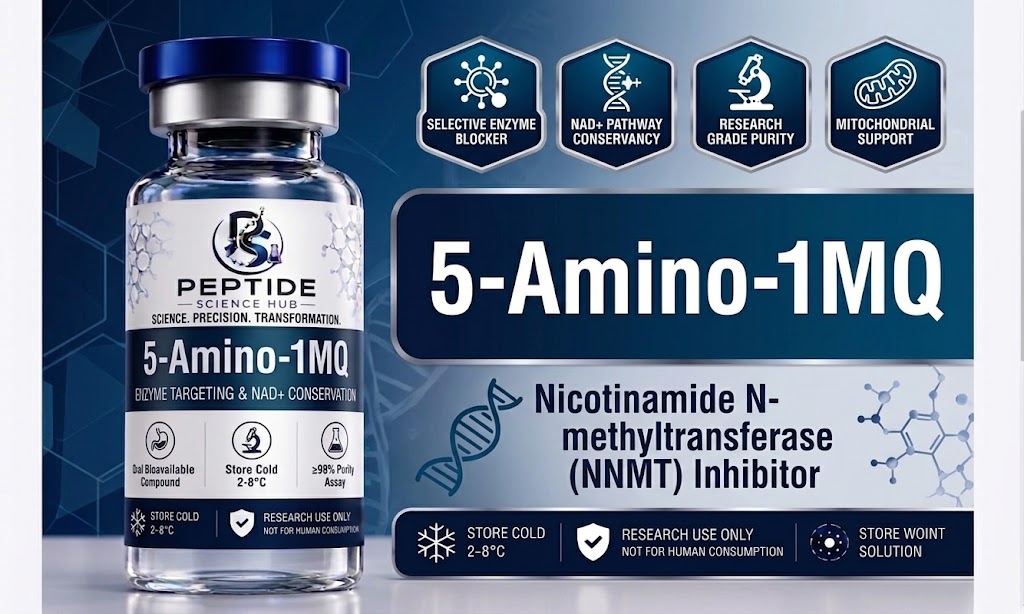
If you’re looking to support your metabolic health at the cellular level, you should seriously consider whether to buy 5-amino-1mg. This innovative small molecule has emerged as a highly selective NNMT (nicotinamide N-methyltransferase) inhibitor that targets fat oxidation through a mechanism entirely distinct from GLP-1 agonists. When you buy 5-amino-1mg, you’re choosing a compound that works by conserving nicotinamide for NAD+ production, activating SIRT1, and promoting mitochondrial biogenesis. This guide covers everything from the science and dosing to safety and where to buy 5-amino-1mg from trusted sources.
The Science Behind NNMT Inhibition
Understanding the NNMT Enzyme
Nicotinamide N-methyltransferase is a cytosolic enzyme that catalyzes the methylation of nicotinamide using SAM (S-adenosylmethionine) as the methyl donor. When NNMT is overactive, it acts as a “methylation sink,” depleting SAM and diverting nicotinamide away from the NAD+ salvage pathway. This impairs cellular energy metabolism and contributes to metabolic dysfunction. When you buy 5-amino-1mg, you’re getting a compound specifically designed to inhibit this enzyme.
Mechanism of Action
5-amino-1-methylquinolinium (5-amino-1mg) is a small, membrane-permeable molecule that acts as a potent, selective NNMT inhibitor (IC50 = 1.2 μM). By competitively inhibiting NNMT, it prevents the depletion of nicotinamide, forcing it back into the NAD+ salvage pathway and elevating intracellular NAD+ levels. Elevated NAD+ subsequently activates SIRT1 (Sirtuin 1), a critical regulator of mitochondrial biogenesis, lipid metabolism, and energy expenditure. This is why researchers choose to buy 5-amino-1mg for metabolic studies.
Landmark Research Supporting This Compound
The Kraus 2014 Landmark Study
The foundational scientific rationale for NNMT as a metabolic target came from a 2014 study by Kraus, Yang, Kong, and colleagues published in Nature. The investigators used antisense oligonucleotides (ASO) to knock down NNMT expression specifically in white adipose tissue and liver of diet-induced obese C57BL/6 mice over 8 weeks. NNMT-ASO-treated mice showed significantly reduced body weight gain (p < 0.05), reduced fat mass as a percentage of body weight (p < 0.05), improved glucose tolerance (p < 0.05), decreased serum insulin (p < 0.05), and reduced hepatic triglycerides (p < 0.05). These findings form the basis for why researchers continue to buy 5-amino-1mg for metabolic research.
Preclinical In Vivo Studies
In diet-induced obese mice, 5-amino-1mg (20 mg/kg/day, subcutaneous) showed progressive weight loss over 11 days with significantly reduced white adipose mass, lowered total cholesterol, and no significant impact on food intake — confirming that weight loss is metabolically driven, not anorexigenic. This makes it a compelling compound to buy 5-amino-1mg for those seeking metabolic support without appetite suppression.
https://images.unsplash.com/photo-1576091160550-2173dba999ef?w=800&q=80
Alt text: Scientific diagram showing the mechanism of 5-amino-1mg as an NNMT inhibitor, illustrating why researchers buy 5-amino-1mg for metabolic studies.
Quantitative Benchmarks
| Biomarker / Parameter | Model System | Vehicle Control | 5-amino-1mg Treated |
|---|---|---|---|
| Intracellular 1-MNA | 3T3-L1 Adipocytes | 100% (Baseline) | ~20–30% of Control |
| Intracellular NAD+ | 3T3-L1 Adipocytes | 1.0x (Baseline) | 1.2x to 1.6x Increase |
| Body Weight Gain | DIO Mice (11 Days) | +5.4 g | +0.9 g (High Dose) |
Dosing and Administration Protocols
Standard Dosing Protocol
When you buy 5-amino-1mg, standard research dosing protocols recommend 5–25 mg/day oral, taken in the morning, pre-cardio, or fasted. Typical cycling involves 8–12 weeks on followed by 4 weeks off. Some researchers are experimenting with higher doses (100–300mg+) based on the reasoning that oral bioavailability is ~40–50%, though this remains exploratory territory. Always consult a healthcare provider before starting any new supplement regimen.
Oral Administration
5-amino-1mg is an oral compound. It is not a peptide, and there is no injectable form with established safety data. Since it’s a small molecule, it can be absorbed through the digestive tract, unlike most peptides that get destroyed by digestion. When you buy 5-amino-1mg, ensure you’re purchasing from a supplier that provides third-party testing for purity.
Safety Profile and Considerations
Known Side Effects
Reported side effects are mild: occasional GI upset, headache, and generally good tolerability in limited reports. In published preclinical studies, Neelakantan et al. (2018) observed no observable adverse effects in treated mice over 11 days, no significant impact on food intake, and no behavioral abnormalities noted.
Who Should Be Cautious
-
Pregnant or breastfeeding individuals – No reproductive safety data exists
-
Individuals with known or suspected malignancy – NNMT is expressed in cancer types
-
Individuals taking medications affecting methylation pathways
-
Individuals with hepatic or renal impairment
Theoretical Considerations
NNMT is expressed in multiple cancer types, and the effect of pharmacological NNMT inhibition on tumor biology in humans is unknown. Individuals with active malignancies should avoid NNMT inhibitors until the effects are better understood. No drug interaction studies have been conducted for 5-amino-1mg.
Why This Compound Stands Out
5-amino-1mg’s mechanism is metabolically interesting and the basis for its fat-loss rationale. The NNMT pathway is not sex-specific, and women have used it with the same general approach as men. By targeting visceral fat breakdown through a mechanism distinct from GLP-1 agonists, 5-amino-1mg can be stacked alongside GLP-1 therapies to optimize body recomposition. This is why many choose to buy 5-amino-1mg as part of a comprehensive metabolic stack.
https://images.unsplash.com/photo-1588776814546-1ffcf47267a5?w=800&q=80
Alt text: Metabolic pathway diagram showing NAD+ biosynthesis and NNMT inhibition by 5-amino-1mg, helping customers understand why to buy 5-amino-1mg.
Take the Next Step Today
The evidence base for 5-amino-1mg is compelling: selective NNMT inhibition, restored NAD+ levels, enhanced fat oxidation, and no appetite suppression. If you’re ready to support your metabolic health with this innovative small molecule, start by consulting a licensed healthcare provider to determine if 5-amino-1mg is right for you. Don’t wait – the sooner you buy 5-amino-1mg, the sooner you can experience the cellular-level metabolic support that researchers are increasingly excited about. Take charge of your health and buy 5-amino-1mg today from a trusted research supplier.
Internal Resources
-
Which GLP-1 Are Approved for Weight Loss? – Understand which products carry FDA weight management indications.
-
Understanding NNMT Inhibition and Metabolic Health – Deep dive into the science of NNMT before you buy 5-amino-1mg.
-
5-amino-1mg Dosing and Titration Guide – Everything you need to know about starting and adjusting your dose when you buy 5-amino-1mg.
-
5-amino-1mg Stacking Guide with GLP-1 – How to integrate 5-amino-1mg into a comprehensive protocol.
-
Semaglutide vs. Tirzepatide: Comparison – Compare GLP-1 options.
-
Weight Management Protocols – Learn about personalized metabolic protocols.
-
Precision Peptide Genetic Test for GLP-1 Response – Discover if your genetic profile supports personalized therapy.
-
NAD+ Boosting Strategies Guide – Compare 5-amino-1mg with NMN and NR.
External Resources and Links
-
Sigma-Aldrich: 5-amino-1mg Product Information – Technical specifications and biochemical data.
-
Superpower: 5-amino-1mg Research Guide – Comprehensive mechanism and safety overview.
-
TrimRX: 5-amino-1mg Safety Profile – Complete safety analysis before you buy 5-amino-1mg.
-
PeptIQ: 5-amino-1mg Stacking Guide – Integration with GLP-1 protocols.
-
ClinicalTrials.gov: NNMT Inhibitor Research – Search for ongoing studies.
-
FDA MedWatch: Report Adverse Events – Essential for reporting any issues.
-
PubMed: Kraus et al. 2014 Nature Study – Foundational NNMT research.
-
ScienceDirect: Neelakantan et al. 2018 – Preclinical safety data.
| 5-amino-1mg | 5mg, 50mg |
|---|
Be the first to review “5-amino-1mg”
Related products
Aesthetic
Cognitive Peptides
Aesthetic
Aesthetic
Cognitive Peptides

Immune Peptides
Aesthetic
Cognitive Peptides
Reviews
There are no reviews yet.