
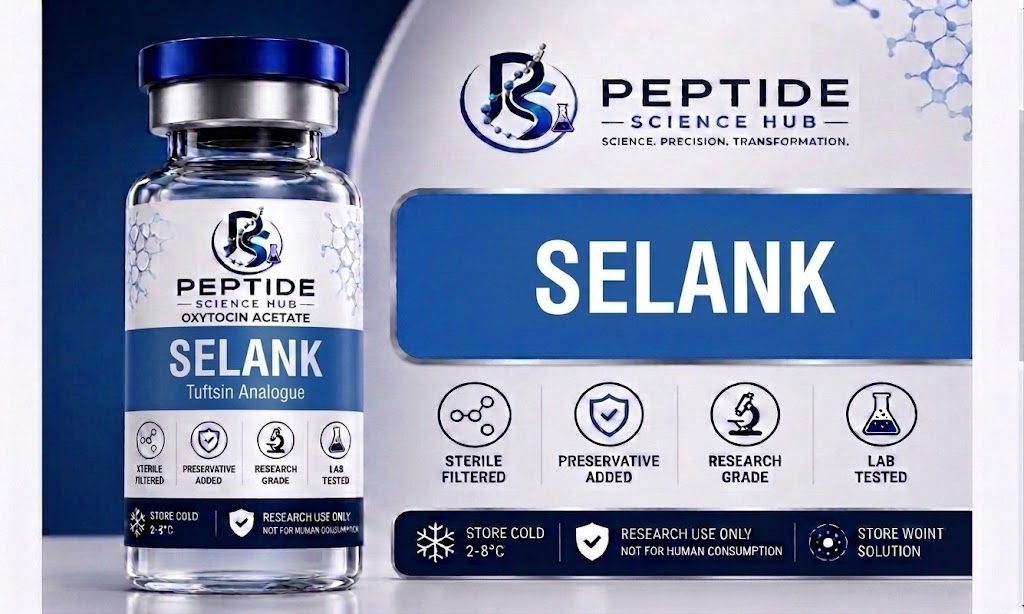

Selank is a synthetic heptapeptide (Thr-Lys-Pro-Arg-Pro-Gly-Pro) developed in Russia as an anxiolytic and nootropic agent. Researchers study it for its potential to reduce anxiety and support cognitive function without the typical sedative or dependence profile of conventional treatments . It is a structural analogue of the endogenous immunomodulatory peptide tuftsin .
[Image Placeholder: Diagram showing Selank’s multi-target mechanism of action]
Alt text: Selank mechanism of action showing GABAergic modulation and enkephalinase inhibition
1. What Is Selank?
Selank is a synthetic heptapeptide with the sequence Thr-Lys-Pro-Arg-Pro-Gly-Pro . The Institute of Molecular Genetics of the Russian Academy of Sciences developed it, and it is registered for generalized anxiety disorder and neurasthenia only in the Russian Federation . Importantly, Selank has no FDA-approved indication for any use in the United States .
2. Mechanism of Action
Selank operates through a multi-target mechanism. Its primary action involves positive allosteric modulation of GABA-A receptors. Unlike benzodiazepines that bind to a specific site, Selank interacts with a different site on the receptor. This enhances the inhibitory effects of GABA without causing sedation .
Selank also inhibits enkephalin-degrading enzymes (IC50 ~15-20 µM). This increases the levels of endogenous opioid peptides with calming properties . Furthermore, it modulates monoamine neurotransmitters and upregulates BDNF expression in the hippocampus, which is crucial for neuronal survival and cognitive function . Additionally, as a tuftsin analogue, Selank can modulate the expression of inflammatory cytokines like IL-6 .
[Image Placeholder: Chart showing Selank’s effects on GABA-A receptors and BDNF upregulation]
Alt text: Selank effects on GABA-A receptor modulation and BDNF expression
3. Research Applications
Preclinical studies have explored Selank’s anxiolytic and nootropic potential. In the elevated plus-maze (EPM) test, Selank showed efficacy in stressed rats . It also normalized investigative activity in adult rats subjected to antenatal hypoxia .
A clinical trial compared Selank to the benzodiazepine medazepam in 62 patients with GAD or neurasthenia . A 2024 transcriptomic study showed Selank alters the expression of hundreds of genes in the rat hippocampus during acute stress without affecting genomic activity under normal conditions .
[Image Placeholder: Infographic of Selank’s research applications]
Alt text: Selank research applications for anxiety, stress, and cognitive performance
4. Regulatory Status and Safety
As of 2026, Selank is classified as an FDA Category 2 bulk drug substance . It is not FDA-approved and has no completed Western randomized controlled trial . However, a 2024 FDA notice removed Selank from Category 2 after the nominator withdrew its nomination, although it remains under review for potential inclusion in the 503A Bulks Regulation . Recently, there have been announcements that Selank may be reclassified as Category 1 .
Common side effects include nasal mucosa irritation and rare allergic reactions . It is contraindicated during pregnancy and breastfeeding . Products sold through unregulated online vendors lack pharmaceutical-grade manufacturing standards and may contain contaminants or incorrect concentrations . For more on peptide safety, review our Peptide Safety Guide. Externally, refer to the FDA guidelines on investigational drugs and the PubMed research repository for peer-reviewed literature.
5. Conclusion
Selank is a research peptide with a unique mechanism of action. It presents an interesting case for the study of non-sedating anxiolytics. Nevertheless, its use outside Russia remains in the research domain. Researchers should use it only in controlled settings.
| Selank | 5mg, 10mg |
|---|
Be the first to review “Selank”
Related products

Uncategorized
Uncategorized
Uncategorized
Uncategorized
Peptides Collection

Uncategorized
Peptides Collection
Uncategorized
Reviews
There are no reviews yet.